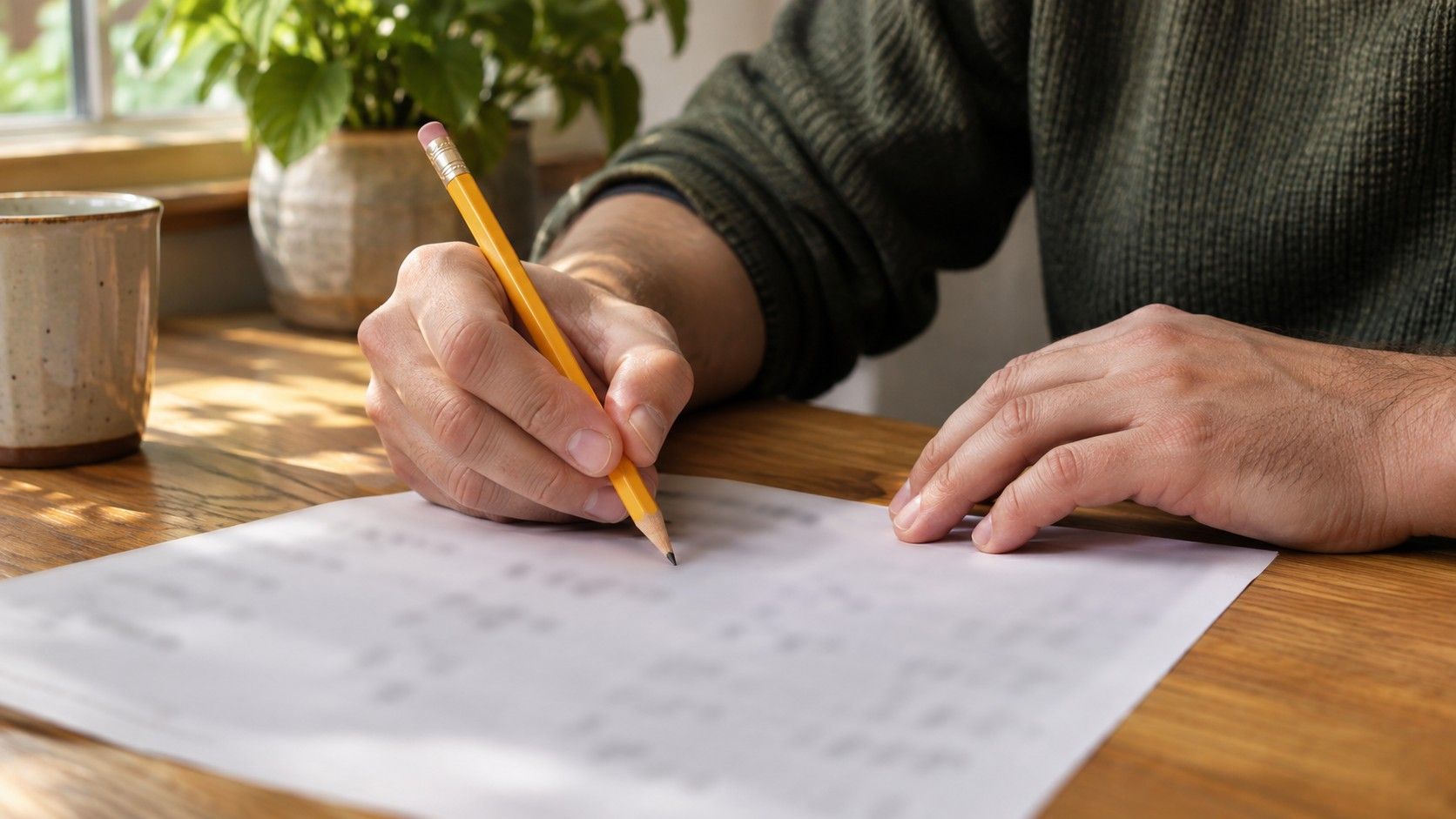
NPOST reading practice should train you to answer from the supplied passage, including when a real-world explanation seems obvious. Time pressure makes it tempting to select an option that resembles the text without checking its full meaning. A repeatable evidence check is more useful than a promise to read faster. Start with unfamiliar passages, explain each choice and add timing once the reasoning is reliable.
Preview the question without losing the passage
Read the question stem to identify the task. It may ask for a detail, a conclusion, the main point or a statement that does not follow. Keep that task in mind while reading the passage, but avoid deciding the answer from the stem alone. A familiar topic can create expectations that the actual wording does not support.
If a passage is short, a complete first read is often more efficient than searching disconnected sentences. Notice who acts, what happens and any limits or exceptions. For longer material, follow the instructions and practise an approach that preserves context. There is no benefit in finding one matching word while missing the condition attached to it.
Do not assume every question requires the same depth of rereading. A named detail may be located directly. A question about the overall point may require comparing several sentences. During review, identify which task consumed the time. That helps you practise a specific method rather than simply demanding faster reading from yourself.
Mark claims by how strongly they are supported
Use levels of support. A fact stated directly is strongest for a detail question. A conclusion may be justified by several facts together, but it cannot depend on an extra event. An attractive possibility remains unknown when the passage lacks evidence. Distinguishing these levels helps you reject choices that are plausible yet too strong.
Watch quantifiers. Some records were incomplete does not mean all records were incomplete. A procedure that may be used in an exception does not become mandatory in every case. Small words can carry the whole distinction between two options, so compare the full claim rather than its main noun.
Keep reported statements separate from observations. If a witness says a gate was open, the passage establishes that the witness made that statement. Depending on the wording, it may not establish that an officer independently verified the gate's condition. Attribution is part of the information, not decoration you can discard.
Work an original incident passage
Here is an original practice passage: During a morning inventory, Lee counted 18 radios in cabinet A and 12 in cabinet B. Four radios from cabinet A were marked for repair. Patel moved those four to a separate repair shelf before the afternoon shift. The inventory note did not state whether the radios in cabinet B had been tested.
Which statement is supported? Four radios were moved from cabinet A to the repair shelf. Which is unsupported? All radios in cabinet B worked correctly. Their presence in the cabinet does not establish their condition. Which number remains in cabinet A after the move, assuming no other changes? Fourteen, because 18 minus four is 14.
Now consider an option saying Patel repaired four radios before the afternoon shift. The passage describes moving them, not completing repairs. A second option saying cabinet B contained fewer radios than cabinet A at the morning count is supported by 12 versus 18. The time reference matters: do not silently change a morning comparison into a later one.
Reject options that change one small detail
A good distractor may preserve most of a sentence while changing one important feature. Compare actor, action, timing, quantity and certainty. Moved becomes repaired; before becomes after; four becomes all. Checking these features is more dependable than selecting whichever option shares the most words with the passage.
Reject answers for a specific reason. Too broad, wrong actor and unsupported cause are useful labels. Sounds wrong is not. When two options appear close, identify the exact word that would need to change for the weaker one to become supported. This turns a vague disagreement into a concrete reading exercise.
Avoid importing job knowledge into a passage unless the instructions expressly call for it. You may know a procedure that would normally occur after an event, but that does not prove it occurred in the fictional account. The task is to understand the information provided under the stated rules, not complete a realistic story from memory.
Train accuracy before shortening the clock
Begin with a few passages and generous review time. For every answer, point to the supporting text or explain the missing evidence. Then take a fresh set under a modest time limit. Record whether mistakes appear near the end, after a difficult passage or mainly on one question type. Patterns are more useful than a single overall percentage.
If you run short of time, examine the process before forcing a faster pace. Repeatedly reading an entire passage when only one detail is disputed can waste time. Skipping the passage and guessing from word matches creates a different problem. Practise locating the relevant sentence while preserving its qualifier and context.
Keep the actual test's current timing and navigation instructions separate from your personal drills. A practice site may allow unlimited review or pauses that the examination does not. Use realistic conditions for later rehearsals, but let early sessions teach the skill properly. Understanding the method comes before measuring how quickly you can apply it.
After reviewing, rewrite one wrong option into a supported statement and explain the change. In the radio example, replace repaired with moved to the repair shelf. That tiny editing exercise checks whether you understood the distinction. Use a different passage the next day so remembered wording does not masquerade as improved comprehension.